Apple Juice 30 Minutes Before Breakfast Lowered the Blood Sugar Peak in a Small Trial. Here's What Changed and What Didn't
Researchers in Beijing gave the same glass of apple juice to the same people on two mornings. The only difference was timing: 30 minutes before breakfast, or with it. Drinking it first lowered the highest point blood sugar reached after the meal. It didn't reduce the total amount of sugar that entered the bloodstream.
RecipesForJuicing editorial team · Published
What the Researchers Tested
The study comes from a nutrition team at China Agricultural University in Beijing. It was published in early November in the journal Nutrients and appeared on PubMed in mid-November. It's a randomized crossover trial, which means every participant tried both conditions on different days and served as their own comparison. That design suits small studies, because differences between people don't muddy the result.
Here's the setup:
- Who: 20 healthy adults enrolled in March 2026, and 19 produced usable data. One person's glucose sensor fell off. The group was young (median age 23), mostly women (14 of 19) and of normal average weight. Everyone already drank fruit juice regularly. People with diabetes or other conditions affecting blood sugar were excluded.
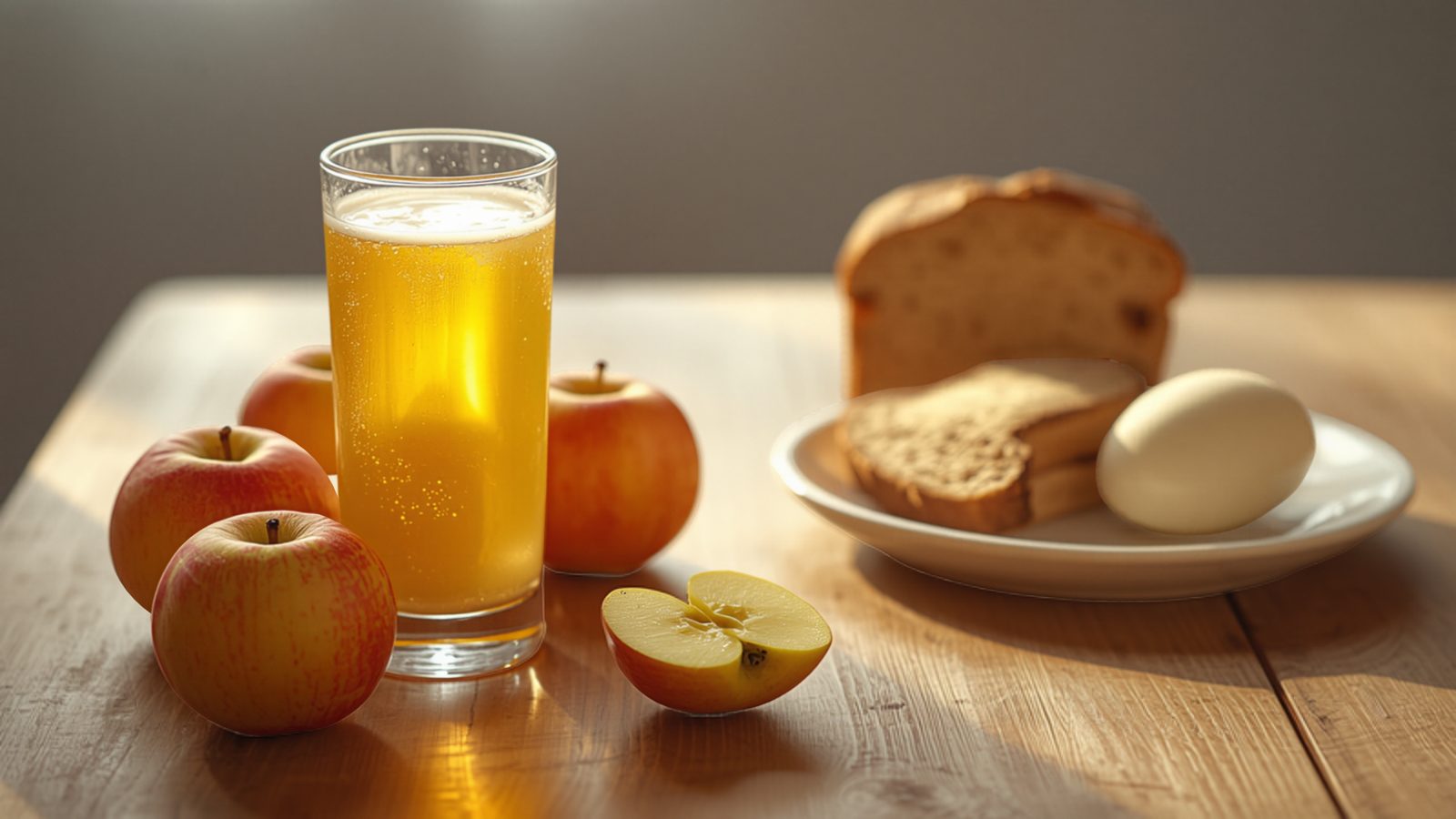
- The juice: 200 mL (about 6.8 oz) of a store-bought 100% apple juice, with roughly 25 g of carbohydrate per serving.
- The breakfast: 100 g of whole-wheat bread and one boiled egg, about 50 g of carbohydrate.
- The two conditions: On one day, participants finished the juice within 5 minutes and ate breakfast 30 minutes later (the "preload"). On the other, they had the juice with breakfast. Four days separated the two test days.
- The measurement: An Abbott FreeStyle Libre continuous glucose monitor on the upper arm. Lunch and dinner were standardized and eaten on site, so the researchers could see whether any effect carried over to later meals.
The Results, in Plain Numbers
The main question was how high blood glucose climbed after breakfast. On that measure, drinking the juice first helped:
- Peak glucose averaged 6.28 mmol/L (about 113 mg/dL) with the preload, compared with 6.78 mmol/L (about 122 mg/dL) when juice came with the meal. That's a difference of 0.51 mmol/L, or about 9 mg/dL.
- The size of the spike, measured as the rise above the starting level, was also smaller: about 0.42 mmol/L (roughly 8 mg/dL) less, or around 15% smaller on average.
- Total glucose exposure didn't change. The area under the glucose curve over the 3.5 hours after time zero was essentially the same in both conditions (2.52 versus 2.59 mmol/L·h, a difference that wasn't statistically significant).
- Lunch and dinner were unaffected. No glucose measure differed between the two days once the later meals were eaten.
The authors describe this as a change in the shape of the glucose response rather than a reduction in sugar. That framing is honest and worth keeping in mind. The same 25 g of juice carbohydrate went into the body either way. Drinking it first spread the arrival of sugar over a longer window: the juice was absorbed in the half hour before the bread arrived, so the two loads didn't stack into one taller peak.
They also ran a second analysis that started the clock at breakfast instead of at the juice. That version shows a much larger benefit, but the authors point out that it isn't a fair comparison. By then, most of the preload juice had already been absorbed, so that window contained about 25 g less carbohydrate. Headlines that quote the bigger figure are describing that mismatch, not the effect of timing.
Check your own glass
See how much sugar your morning juice carries
The study's glass had about 25 g of carbohydrate. Enter the produce you actually press to see where your own recipe lands, and how much swapping in cucumber or greens changes it.
Open the Nutrient Calculator →How Much Should You Read Into It?
Less than a headline might suggest, and the authors say much the same thing. A few reasons for caution:
- It's small. With 19 people analyzed, the confidence interval for the peak reduction runs from 0.07 to 0.94 mmol/L. That range covers anything from a negligible effect to one bigger than the trial was designed to detect.
- The participants were young and healthy. Their glucose peaks stayed well within normal ranges on both days. Nobody knows yet whether the pattern holds for older adults, people with prediabetes or anyone with diabetes. The study can't tell you that.
- A 9 mg/dL lower peak may or may not matter. The authors write that no study has established whether a peak reduction of this size is clinically meaningful.
- One juice, one breakfast. It was a single commercial apple juice before a bread-and-egg meal. A different juice, a bigger serving or a sugarier breakfast could behave differently.
On the plus side, the funder was a regional Chinese government science fund that, according to the paper, had no role in the design or analysis. The authors declare no conflicts of interest, and glucose was recorded objectively by sensor rather than self-reported. Blinding wasn't possible, since participants obviously knew when they drank the juice. But it's hard to see how that would bias a sensor reading.
The finding also fits a broader body of work. Earlier trials, mostly with whole apples, oranges or pears eaten before rice meals, found that a fruit "preload" can soften the glucose rise from the meal that follows. This trial is one of the first to test the idea with juice, which has no fiber and no intact cell walls to slow absorption. It also echoes the South Korean pilot study we covered in August, where a green cold-pressed juice drunk before bread trimmed the post-meal rise. Two small studies in healthy adults point the same way, but that still isn't proof.
What This Means If You Juice at Home
- If you already drink juice with breakfast, having it first is a free experiment. Pour your glass when you get up and eat about half an hour later. It costs nothing and changes nothing else about your diet. Just don't treat it as a way to drink more juice.
- Timing doesn't change the sugar. The total glucose exposure was the same either way. If cutting sugar is your goal, the glass itself matters more than when you drink it. A smaller pour, or a blend built on cucumber, celery or leafy greens with apple as the sweetener rather than the base, will do more than any timing trick. Our juice nutrition guide covers how different produce compares.
- Homemade apple juice isn't automatically gentler. Fresh-pressed apple juice keeps more flavor and some fragile compounds, but it carries roughly the same sugar per glass as a good bottled 100% juice. The study's 200 mL serving is a sensible size to keep in mind, smaller than many glasses people pour at home.
- Whole fruit is still the benchmark. Earlier preload trials used whole fruit, and its fiber gives it advantages juice doesn't have, as we discussed in our piece on the 371,000-person whole fruit and juice survey. Juice works best alongside whole fruit, not as a replacement for it.
- If you have diabetes or prediabetes, check before you change anything. These results come from healthy young adults. Talk with your doctor or diabetes educator, and if you wear a glucose monitor, your own readings will tell you far more than this study can.
The Bottom Line
- In a randomized crossover trial of 19 healthy young adults, drinking 200 mL of 100% apple juice 30 minutes before breakfast, instead of with it, lowered the post-breakfast glucose peak by about 9 mg/dL.
- Total glucose exposure didn't change, and lunch and dinner weren't affected. The timing changed the shape of the spike, not the amount of sugar.
- The sample was small, healthy and young, and the clinical value of a peak that much lower is unknown. Larger trials are needed, including in people with impaired glucose control.
- For home juicers, moving your glass earlier is a harmless experiment, but portion size and the produce in your blend still matter more for sugar.
The researchers want to see the result repeated in bigger, more varied groups before anyone turns it into advice. Until then, it's a useful nudge for people who already enjoy a morning glass: drinking it a little before you eat seems to soften the peak, while what goes in the glass and how much you pour still set the sugar.
Source: Ren J, Feng Y, Zhu R, He J, Zhang Q, Wang R, Guo J (China Agricultural University) — "Effect of Timing of Apple Juice Consumption on Postprandial Glycemia: A Randomized Crossover Trial," Nutrients 2026, 18(21), 3657, published November 2026 (trial registration ChiCTR2600121025), https://doi.org/10.3390/nu18213657. PubMed record: https://pubmed.ncbi.nlm.nih.gov/43030284/. Glucose figures were converted from mmol/L to mg/dL by RecipesForJuicing (1 mmol/L ≈ 18 mg/dL) and rounded.
How Sweet Is Your Morning Glass?
Compare the sugar and calories in an apple-heavy blend with a greens-first version before you press.
Open Nutrient Calculator →