A New Study Found Vegetable Juice Before Bread Cut Blood Sugar Spikes 10% — Here's What It Actually Showed
A small South Korean pilot study just gave the "drink your greens" crowd something more concrete than a hunch: a specific vegetable juice blend, paired with a carb-heavy food, measurably softened the blood sugar spike that followed. The effect is real but modest, the study is tiny, and the headline number needs context most coverage skipped.
RecipesForJuicing editorial team · Published
What the Researchers Actually Did
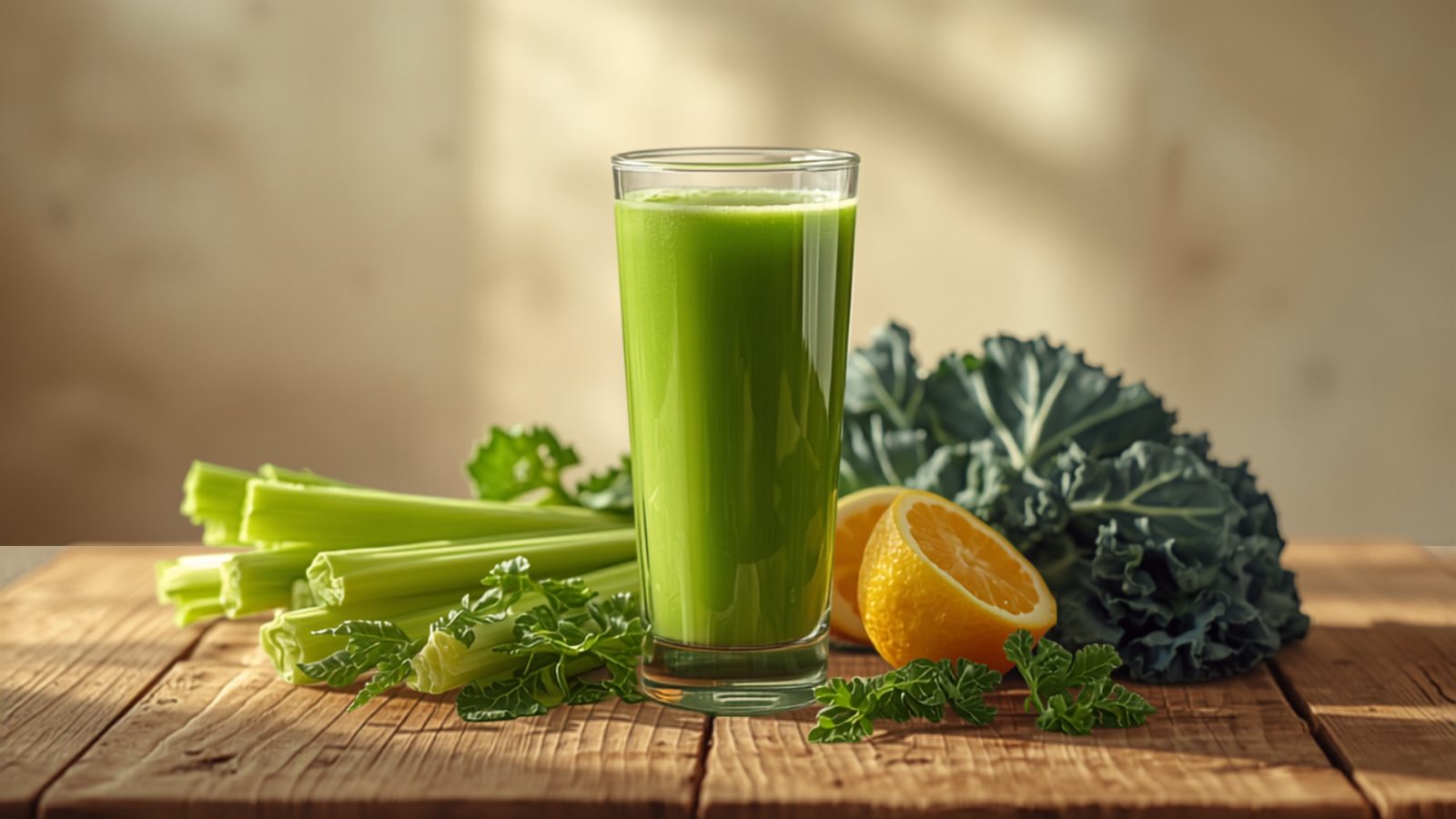
A team led by Professor Kwak Jeong-hyeon in the Department of Food and Nutrition and Food Engineering at Inje University in South Korea ran a pilot study on ten healthy adults, published in the Journal of the Korean Society of Food Science and Nutrition under the title "Effects of Cold-Pressed Juice Composition Combined with Carbohydrate Foods on Glycemic Responses in Adults: Pilot Study." Each participant drank 240ml of one of two cold-pressed juice blends — a celery-cabbage-apple mix and a celery-kale-cabbage-lemon mix — both on its own and alongside 100 grams of white bread, while researchers tracked blood glucose at set intervals afterward.
On its own, either juice barely moved the needle — no surprise, since both blends are low in the kind of concentrated, fiber-stripped sugar that spikes blood glucose fastest. The more interesting result showed up when juice was paired with the bread. The celery-kale-cabbage-lemon blend reduced the 30-minute glucose reading by roughly 4% across the full group compared to drinking water with the same bread. Narrow that down to just the non-obese participants, and the peak blood sugar reading dropped about 10% — from an average of 162.2 mg/dL down to 145.6 mg/dL.
Why a Vegetable Juice Would Blunt a Bread Spike
The researchers point to three overlapping factors rather than one single mechanism. First, both blends are low in sugar to begin with, so they're not adding fuel to the spike the way a fruit-heavy juice would. Second, the produce involved — celery, kale, cabbage — carries polyphenols, plant compounds increasingly studied for a role in slowing how quickly the body absorbs glucose from a meal. Third, and more specific to the winning blend, lemon juice has some evidence behind it for inhibiting digestive enzymes that break starch down into absorbable sugar, which would slow the *rate* bread's carbohydrates hit the bloodstream even if the total carb load doesn't change.
That combination — low sugar input, plus compounds that appear to slow absorption of sugar from a separate food eaten around the same time — is a meaningfully different story than what most people assume "juice and blood sugar" means. This isn't about juice being gentler on glucose than juice usually gets credit for. It's about a specific low-sugar vegetable blend acting almost like a buffer for a different, carb-heavy food eaten at the same sitting.
Try the blend yourself
See the real nutrition numbers behind a celery-kale-lemon juice
Curious what a celery-kale-cabbage-lemon blend actually delivers per glass — sugar, fiber, and more? Plug your own ratios into the calculator and see the real numbers, not just what the study reported.
Open the Nutrient Calculator →Where the Study Falls Short
The researchers themselves were upfront about the limits here, calling it a "small-scale pilot" and cautioning that "the findings should be interpreted as preliminary evidence." Ten participants is not close to enough to draw firm conclusions — it's the kind of sample size meant to justify a larger, better-funded follow-up study, not to change anyone's breakfast routine on its own. There's no word yet on whether the effect holds up in people managing diabetes or prediabetes specifically, which is the population that would actually benefit most from a real answer here. And the 10% figure, the one most likely to end up in a headline, only applied to the non-obese subgroup — the full-group number was a much less dramatic 4%.
It's also worth separating this from a different, more familiar warning about juice and blood sugar: that juicing strips out fiber and can make fruit-heavy juices spike glucose *faster* than eating the same fruit whole. That concern is still valid and applies to sweeter, fruit-forward juices. This study is about something narrower — a specific low-sugar vegetable blend, consumed alongside a carbohydrate food, not instead of one.
Medical disclaimer: This was a 10-person pilot study in healthy adults — it did not test people managing diabetes, prediabetes, or other blood sugar conditions, and its results shouldn't be read as guidance for those groups. Juice is not a substitute for prescribed diabetes medication or medical monitoring. If you're managing blood sugar for a diagnosed condition, talk to your doctor before changing what you eat or drink around meals.
What the Researchers Actually Recommend
Rather than framing this as "add juice to lower your blood sugar," the research team's practical suggestion was more specific: pair vegetable juice with protein and fat sources — eggs, nuts — rather than leaning on carbohydrate-heavy breakfasts like bread or cereal in the first place. In other words, the juice isn't positioned as a fix for a high-carb breakfast so much as a small mitigating factor if you're going to eat one anyway. A balanced plate still does more work than any beverage poured alongside it.
For anyone juicing at home who wants to try something close to what was tested, the ratio was simple: celery, kale, cabbage, and a splash of lemon, cold-pressed rather than blended so the fiber stays out and the texture stays smooth. A masticating juicer handles all four ingredients well — celery and kale in particular benefit from a slower-turning auger that extracts more juice per pound than a centrifugal machine.
The Bottom Line
- A pilot study from Inje University in South Korea found that a celery-kale-cabbage-lemon cold-pressed juice, drunk alongside white bread, reduced participants' 30-minute blood glucose reading by about 4% versus water — and by about 10% among non-obese participants specifically.
- The effect is attributed to the juice's low sugar content plus polyphenols and lemon's enzyme-inhibiting properties, which together appear to slow how fast the bread's carbohydrates raise blood sugar.
- The study had just 10 participants and its authors call it preliminary — not evidence to change anyone's diet on its own.
- This is distinct from the well-established caution that fruit-heavy juices, stripped of fiber, can spike blood sugar faster than eating the same fruit whole.
- The researchers' actual recommendation: pair vegetable juice with protein and fat (eggs, nuts) rather than relying on it to offset a carb-heavy breakfast.
Source: The Herald Business — "Vegetable cold-pressed juice cuts post-meal blood sugar by 10%, study finds," August 10, 2026, https://mbiz.heraldcorp.com/article/10835566
Know What's In Your Glass
Build your own celery-kale-cabbage-lemon blend and see the real sugar and nutrient breakdown per serving.
Open Nutrient Calculator →Related Guides
A masticating juicer gets more out of celery and kale
Slow-turning augers extract more juice per pound from fibrous greens than centrifugal machines — closer to what the study's cold-pressed blend actually was.
Shop Juicers on Amazon →* Amazon affiliate link