Kuvings Just Launched a Smaller, Cheaper Hands-Free Juicer — What the AUTO9 Actually Changes
Automatic, walk-away juicing has been a $700 club for the last couple of years. Kuvings' new AUTO9 is the first serious attempt to bring that format down to a compact machine and a sub-$500 price. Here's what the numbers say it can do, what it quietly gives up to get smaller, and whether "hands-free" is the feature worth paying for.
RecipesForJuicing editorial team · Published
What Kuvings Actually Announced
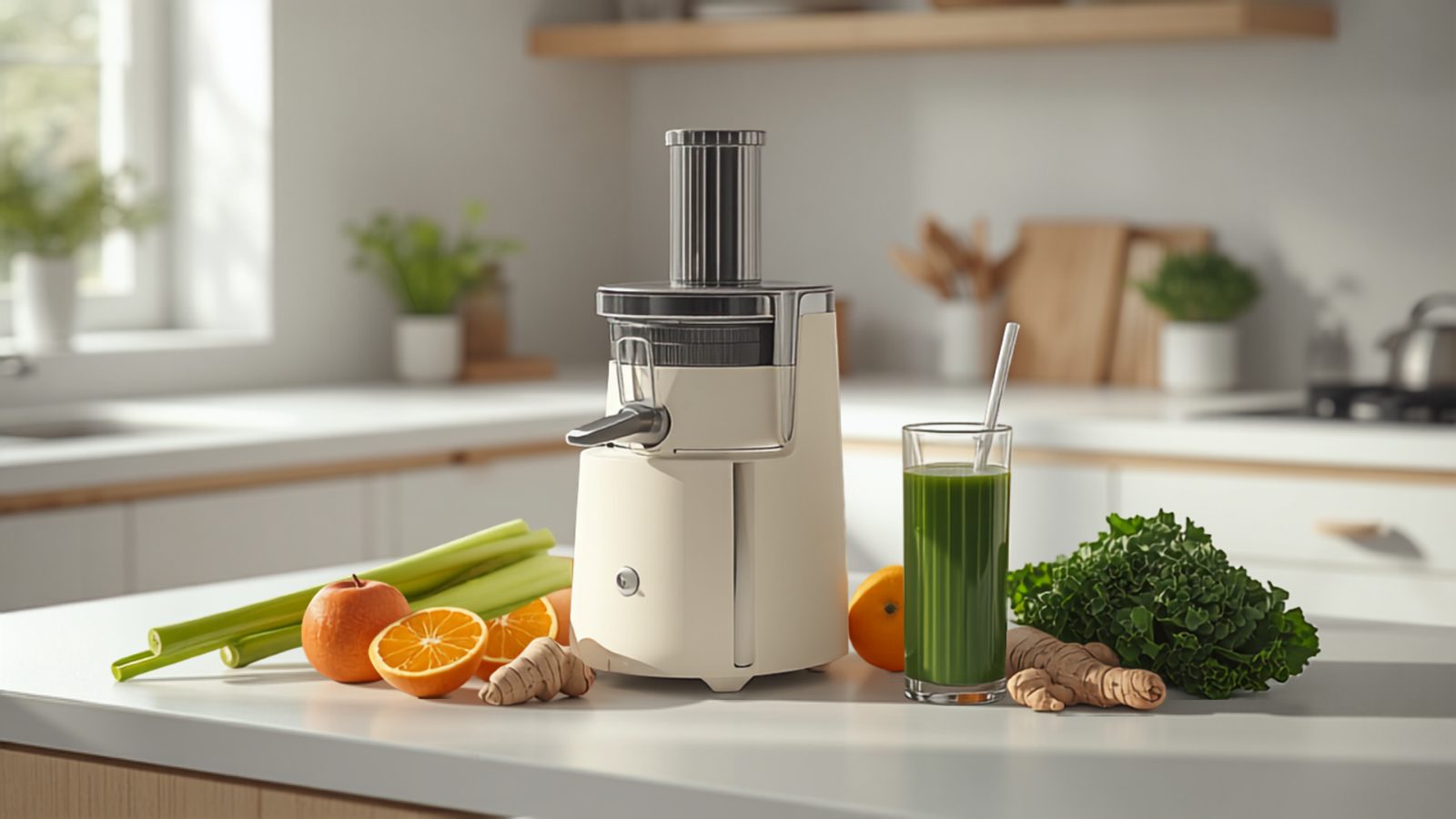
Kuvings, the South Korean brand that helped popularize wide-chute slow juicers, has added a model called the AUTO9 to its hands-free line. The pitch is the same one the category was built on: load whole fruit and vegetables into a lidded hopper, walk away, and come back to a jug of juice. What's new is the size. The AUTO9 is built around a 2-liter auto-cutting hopper rather than the roughly 3-liter bin on the larger AUTO10 machines, and it carries a launch price in the neighborhood of $500 — a few hundred dollars below where automatic juicing has been sitting. Kuvings is positioning it squarely at one- and two-person households and kitchens where counter space is the real constraint.
The "auto" part refers to a cutting blade inside the hopper that chops produce and feeds it into the juicing screw on its own, so there's no pre-slicing and no tamping rod. Two strainers ship in the box, which lets the same machine turn out nut and oat milks or a soft-serve-style sorbet in addition to juice.
The Specs, and What They Tell You
The headline numbers are modest by design. A 200-watt motor turns the auger at about 60 rotations per minute, and Kuvings rates continuous run time at under 20 minutes before the machine needs a rest. The body is roughly 19 × 22 × 46 cm and weighs about 5.4 kg (12 lb), with food-grade, BPA-free plastics throughout.
A few things worth reading into that. The 60 RPM figure is genuinely slow, which is the point — a low-speed squeeze introduces less air and heat than a high-speed centrifugal juicer, so the juice separates less and tends to keep better in the fridge. The 200-watt motor and 20-minute ceiling, on the other hand, tell you this is a machine sized for a glass or two at a time, not for someone who blocks out Sunday afternoon to bottle a week of juice. And the auto-cut hopper is the part that removes the most tedious step in home juicing: the chopping. It does not remove the washing, the pitting of stone fruit, or the cleanup afterward.
Run the numbers first
Work out what a $500 juicer actually needs to earn back
Before any new machine is worth it, the math has to work. Enter the produce you'd really use and how often you'd juice, and the Price Calculator shows your cost per glass — and roughly how many glasses it takes to cover the hardware versus buying bottled cold-pressed.
Open the Price Calculator →What "Hands-Free" Does and Doesn't Solve
The most common reason people stop juicing isn't the machine — it's the ten to fifteen minutes of prep and the sink full of parts afterward. A hands-free hopper takes a real bite out of the first half of that problem. You still wash the produce and remove pits and tough rinds, but you skip the cutting board and the slow business of pushing pieces down a chute one at a time. For anyone who juices most mornings, that saved time compounds.
The cleanup half is mostly untouched. On this style of juicer the parts are not dishwasher-safe, and you're still rinsing a strainer, an auger, a bowl, and now an auto-cutting assembly that is one more component than a manual model has. Fibrous loads like celery and leafy greens leave pulp that needs scraping either way. Some competing hands-free machines — Nama's J2, for instance — add a rinse-through cycle that helps between batches, but it's a pre-rinse, not a substitute for taking the parts apart and washing them. Treat "hands-free" as a claim about the front end of juicing, not the back end.
AUTO9 vs. the Bigger Machines
Against Kuvings' own AUTO10 and AUTO10 Plus, the AUTO9 trades capacity for size and price. The step-up models use a stronger induction motor (around 240 watts), run closer to 45 minutes at a stretch, and hold a larger hopper, at prices roughly in the $700–$740 range. If you routinely juice for a family, batch several days at once, or push a lot of celery and hard roots through, that extra headroom matters and the smaller machine will feel cramped. If you're making one or two servings a day for yourself or a couple, the AUTO9's lower ceiling is unlikely to be the thing you notice — the smaller footprint and the lower price will be.
Should This Change Your Juicer Shopping?
If you already own a slow juicer you're happy with, the honest answer is no. The AUTO9's advantage is convenience, not a better glass of juice; a $150 manual masticating juicer and this machine produce broadly similar results from the same produce. The case for spending more is behavioral: the juicer that pays for itself is the one that stays on the counter and gets used, and lowering the friction to "drop fruit in, press a button" is a legitimate way to keep a habit alive. Just make the decision on math and honesty about your routine — check that your usual produce fits the feed opening, price out your cost per glass, and be realistic about how many mornings a week you'll actually run it before deciding a hands-free machine is worth two or three hundred dollars over a standard one.
The Bottom Line
- Kuvings has launched the AUTO9, a compact hands-free slow juicer with a 2-liter auto-cutting hopper, a 200-watt motor at about 60 RPM, and a launch price around $500 — roughly $200 below its larger AUTO10 models.
- It's aimed at one- and two-person households and small kitchens; continuous run time caps at under 20 minutes, so it's not built for bottling a week of juice at once.
- "Hands-free" removes the chopping and tamping, not the washing or the cleanup — the parts still aren't dishwasher-safe.
- The bigger AUTO10 machines offer a stronger motor, longer run time, and more capacity for about $700–$740, which matters for families and heavy celery-and-greens juicers.
- If you already juice happily, the gain here is convenience, not juice quality — decide based on your real weekly routine and cost per glass, not the newness of the format.
Source: HomePage News — "Kuvings Adds Compact 'Auto9' Hands-Free Slow Juicer," September 3, 2026, https://www.homepagenews.com/home-housewares/kuvings-adds-compact-auto9-hands-free-slow-juicer/
Is a New Juicer Worth It?
Price out your real cost per glass and see how long any machine takes to pay for itself against store-bought cold-pressed.
Open Price Calculator →Related Guides
Shopping for a slow juicer?
Hands-free models are one branch of the masticating family. Compare current cold-press and hands-free juicers before you commit.
Shop Slow Juicers on Amazon →* Amazon affiliate link